

Interview overview
Morita Moved a Family of Four to Vancouver Without Hunting a Canadian Employer
A Japan web-services founder timed kindergarten, ignored agents who said impossible, and used Frog’s PEO path so the business could continue while the kids started school—and while he worked Japan hours after bedtime.
Masakazu Morita built a Japan company around client web development and his own services—revenue skewed to client work, energy skewed to products he owned. A Hawaii media site once began as a visa-minded experiment with local writers; staffing proved hard and the project paused. The lasting wish was simply to live abroad someday.
Children’s schooling set the clock. In British Columbia, kindergarten starts the September of the year a child turns five; the family relocated in May 2021 so that timing would work. Canada was not the only English-speaking candidate, but visas, safety, and a usable Japanese information community pointed to Vancouver—especially valuable because neither he nor his wife claimed strong English.
He never planned a conventional Canadian job search. Agents elsewhere mostly said a founder could not stay without local employment—or went silent. When Senna posted about a new Frog initiative on Twitter, Morita leaned into PEO, originally shaped to support Frog members working for U.S. firms and useful for people who wanted a Canadian base without Canadian employers. After arrival he also set up a Canadian corporation to support web-service development.
Life runs child-first: school drop-off, community-center mornings while his wife takes the younger child, nap, pickup, evening lessons. Serious Japan client work often starts around 10 p.m. Vancouver time through 3 or 4 a.m., plus a couple of morning hours—roughly a normal eight-hour day split oddly, with naps totaling six or seven hours of sleep. The Japan time difference makes that night window workable; he had already worked after kids slept in Japan.
A bilingual-researcher friend told him overseas moves land best by about ages seven or eight, when play starts needing rules language. His older child arrived at five with Japanese daycare speech and could map English through Japanese questions; within two years switching felt clean. The younger arrived pre-verbal and mixed languages like a blender before learning who gets which tongue. Home policy is Japanese; English slips get redirected; outside, English if any non-Japanese speaker is present. Supplementary Japanese school fights vocabulary shrinkage that home chat alone cannot stop.
Money advice to peers: Japan engineering rates stagnated while North American—and even some Vietnam—rates moved; living on Japan income in Vancouver eventually hurts. Grow Canada/U.S. revenue share. West Vancouver suits groceries, friends, and milder winters; PR unlocked thoughts of Hawaii or Europe, though returning to Japan still feels likelier than random third countries. Homesickness hit hard enough that full return entered talk—until COVID travel limits kept them long enough for the children to root.
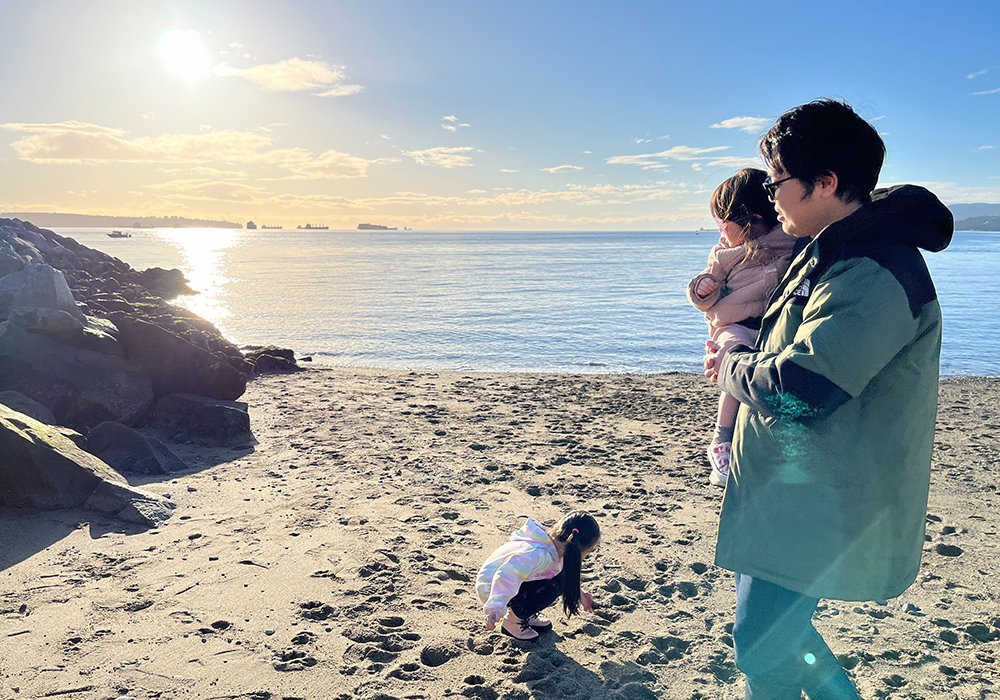
Photos from the interview
This page is an English overview of Frog’s Japanese interview—not a full translation. Read the original interview (Japanese)