

Interview overview
Obara ordered coffee through a Japanese barista—then joined AWS Toronto
A geology graduate who spent five years in cement mining, taught himself into full-stack work, and arrived unable to speak a Starbucks order, Obara used Tim Hortons shifts, CICCC study, and obsessive Leadership Principle prep to become an AWS Customer Support Engineer in Toronto.
Obara’s LinkedIn still startles people who read “mining engineer” as crypto. Fresh from geology, he joined a cement company’s mine operations—years of production management in Yamaguchi—before feeling misfit and discovering joy in Excel VBA macros that collapsed chores into buttons. Night online schooling in Ruby on Rails led to Tunagate, where he wrote Rails, React, and React Native for about two years, then freelanced while keeping Tunagate work alive even after moving to Canada—a rare income bridge that steadied the leap.
Wanderlust wore adventure-fiction clothes: old hitchhiking TV, Midnight Express, shonen quests. Concrete plans arrived via overseas-engineer YouTubers and Frog’s sequenced school–co-op–holiday essays that suddenly made Vancouver feel inevitable. Private life delayed him about two years after a first inquiry; by return contact he was past working-holiday age, so CICCC became the lane. TOEIC climbed from company-benefit 700s toward the mid-800s needed for entry—exam English, not spoken ease. He told himself the technical side would somehow be fine.
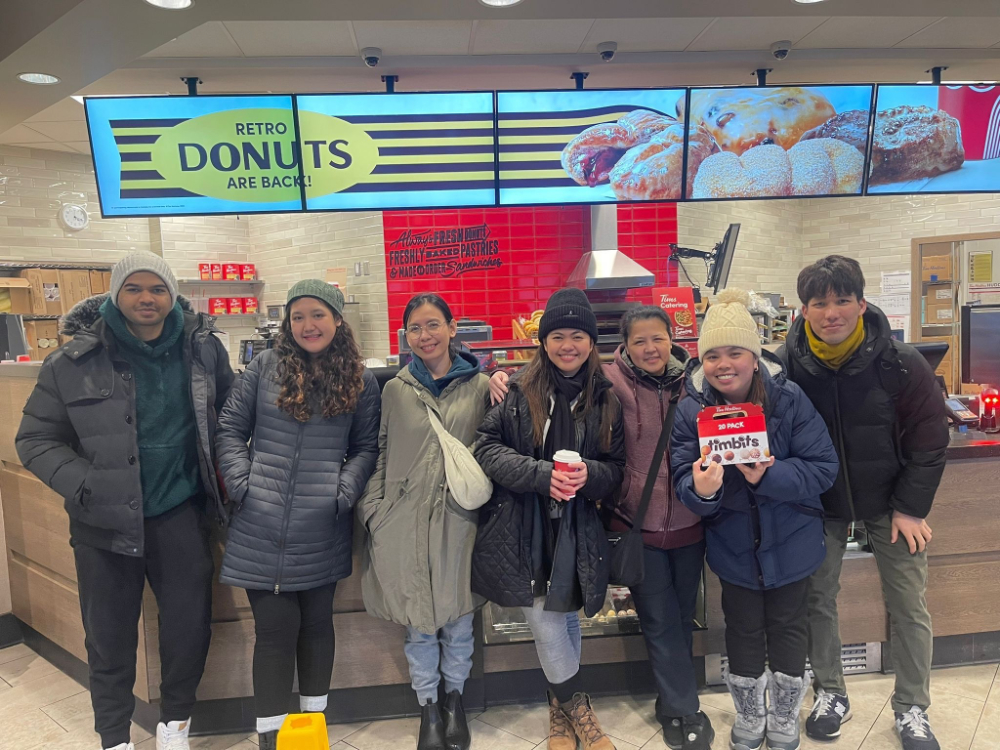
April 2023 arrival exposed the gap immediately: a Starbucks barista fetched a Japanese coworker so he could whisper “black coffee.” Inspired by a Frog story about café English, he papered downtown cafés, failed milk-percentage listening on trial shifts, then got hired at Tim Hortons for about four months of real customer English. By autumn he quit to job-hunt in a recession, sending around fifty applications with almost no traction beyond a couple of dead interviews—including school introductions—while smaller startups scheduled chats too fast for him to feel prepared.
A friend’s LinkedIn Amazon ping prompted him to apply himself through AWS’s forms. With peers aiming the same target, he spent one to two months almost exclusively preparing: roughly thirty Leadership Principles stories matured in advance, mutual mock interviews, OS and networking study for the loop. After a role-adjacent screen and a four-interviewer loop split between behavioral and technical fundamentals, he won a Toronto Customer Support Engineer seat—thrilled enough that leaving Vancouver felt like bonus geography, not sacrifice. Later he would step into a TAM path back in Japan, carrying the proof he had watched inside Frog many times: AWS outcomes tracked preparation hours more than prior vibes.
He later carried Toronto AWS experience into a TAM chapter in Japan, and kept feeding Frog’s Slack even while big-tech Japanese circles can become self-contained. The emotional peak he describes is almost wordless: after fifty ignored applications, hearing AWS say yes did not feel real at first—then it felt like everything. Preparation, not mystique, is the moral he is willing to stand behind.
Even the Starbucks humiliation becomes instructional in his telling: test scores are not spoken fluency, and humility plus café shifts can close a gap that résumés hide. Friends who practiced Amazon loops with him mattered as much as solitary study because they caught wrong directions early. Moving to Toronto for AWS was excitement more than fear; provincial nominee daydreams faded behind the sheer relief of being chosen.
Photos from the interview

This page is an English overview of Frog’s Japanese interview—not a full translation. Read the original interview (Japanese)