
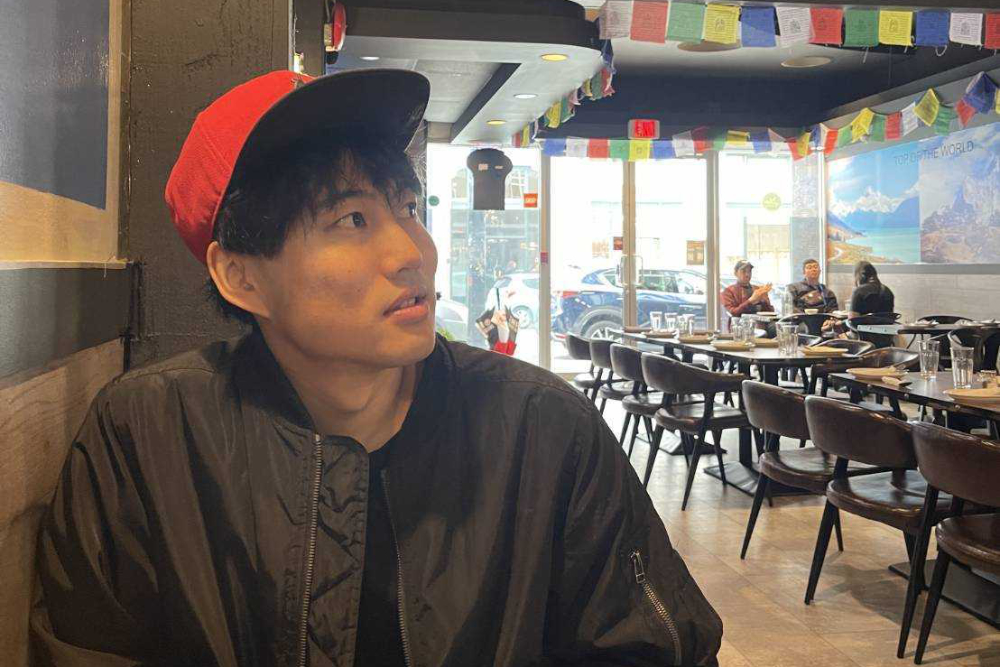
Interview overview
Three Hours of English a Day—Then an AI Firm Before Graduation
Sales, fintech SaaS engineering, Langara Computer Science, roughly eighty applications, and a Vancouver AI services offer while Tomoharu was still a student.
Tomoharu graduated from Aoyama Gakuin University outside computer science. As a new graduate he did sales for about three years, then taught himself programming with a mentor who was a CTO and contract engineer, building Ruby projects on the side. As a fintech startup software engineer for about four years he worked JavaScript and React on the frontend and Ruby on Rails on a SaaS backend. Overseas work interest had existed since the sales years; what changed was discipline. During the engineering period he prepared for IELTS about three hours a day for three years. A first practice test sat at overall 6; Langara needed overall 6.5.
An ex-AWS contact on social media introduced him to Frog; New Zealand was also considered. He chose Langara College Computer Science for about two years, motivated by a longer post-graduation work permit—roughly three years—and a desire for formal CS grounding. In the second half year he freelanced for a Japan company while studying and left that work at graduation. Job prep from about six months into Langara included reading Frog success stories, practicing English, algorithms, and system design, and using ATS and résumé tooling such as Jobscan.
He applied to about eighty companies. Interviews mixed CS and system topics with PM-style behavioral rounds. He received an offer before graduation—attributes list about twenty-four months to offer—at a Vancouver AI contract and services development company whose legal name is not stated. He started part-time while still in college, then moved full-time after graduation. He reports high flexibility versus his Japan SaaS role, global offices, and rough Japan-yen compensation around ten million yen.
The interview’s emotional center is the unglamorous habit: three hours of English daily for three years while shipping fintech product. By the time Langara’s finish line approached, the offer was already in hand—proof that the long prep and the eighty applications were the same project, not two separate careers.
ATS tooling and Frog success stories were not shortcuts so much as mirrors—ways to see whether his résumé survived parsers and whether his interview stories matched people who had already landed. Starting part-time before graduation blurred student and employee identities in a useful way: the AI services firm could trial fit while Langara’s remaining terms finished.
New Zealand stayed on the comparison table until Frog and Langara’s PGWP math won. Freelancing for a Japan company through the back half of college paid bills and complicated calendars until graduation forced a clean cut. Interviews that mixed system design with PM behavioral rounds matched the hybrid engineer he had become—fintech SaaS builder plus deliberate CS student.
Photos from the interview

This page is an English overview of Frog’s Japanese interview—not a full translation. Read the original interview (Japanese)