
Interview overview
Yano’s one-day Canada decision and the year that led to AWS in Toronto
After four years in cleaning-services sales and two years in Japanese IT, Yano chose CICCC on the same day a senior engineer sketched the plan—and about a year after landing in Canada, an AWS manager found him on LinkedIn.
Yano talks about overseas work the way some people talk about unfinished sentences: the wish was always there, even when the résumé was not ready. When he first reached out to Frog in April 2022, his TOEIC sat at 575 and his development experience was still thin. He still boarded for Canada in 2023, and roughly twelve months after arrival he held an offer from AWS in Toronto—then helped lead AWS information sessions for Frog members that later candidates would credit as a real introduction.
His Japanese path was already a series of pivots. At Waseda he entered on a humanities track inside a mixed faculty and finished in a more science-leaning major; he also earned an English teaching license he never used in a classroom. After graduation he spent four years selling cleaning-related services, then jumped into IT as a complete career changer. Programming began almost as a side hobby while he was still in sales. It turned out to be more fun than he expected, so he taught himself, leaned on study communities instead of a bootcamp, and applied straight to companies without freelancing first. Year one was mostly testing with little coding; year two was fullstack work at a product company. By the time he left Japan, his IT tenure was about two years—one of them as a developer.
The Canada decision itself was abrupt. A senior engineer at that product company—someone who had once been a Frog advisee—described a CICCC Co-op path for keeping a visa, building English, and job-hunting in parallel. Yano decided the same day. He had vaguely wanted an English-speaking country for years; junior-high English struggles and a Kumon breakthrough had planted the spark. America was the original dream, but he treated Canada as a practical first step toward big-tech experience and a possible transfer later. Japan-side foreign-affiliate routes barely registered; he wanted to live and work abroad, not just transfer on paper.
Preparation took about a year. Roughly five months of intense study lifted TOEIC from the mid-500s to 870; after clearing the 850 range he added DMM English conversation. He arrived on 29 March 2023. At CICCC he still felt short on English, tech, and money, so outside class he mostly buried himself in libraries alone. The plan had been to start applying immediately. After a cautious first month he flooded the market—about a hundred applications across three recession months—and heard back almost never, sometimes one take-home a month, often failed.
The first Canadian foothold came through CICCC career support: a project that ended in about three months but exposed him to unfamiliar tech and test automation. In September 2023 a Frog Slack post led to a Ruby contract for a firm with Japan and Vancouver bases. He owned design through implementation from supplied designs—demanding work, and not an easy environment, but it put local experience on the résumé.
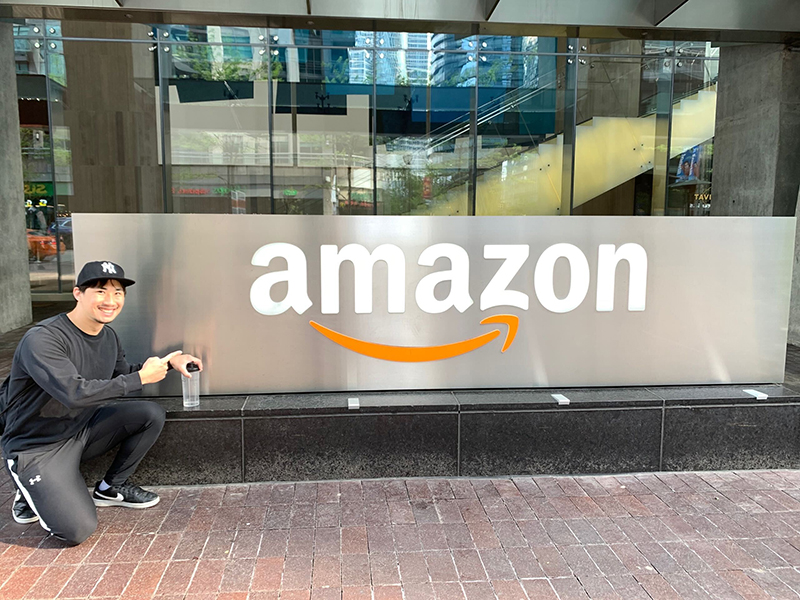
AWS arrived as a LinkedIn direct message from a manager who said his background fit an open role. Yano’s first reaction was suspicion; recruiting scams were common talk among Frog members. What seemed to line up was timing: he already had full-time work authorization, Toronto was expanding, and he had enough English and engineering signal to clear the bar. He also held a startup offer that was turning shaky, so the choice felt less like agonizing and more like taking the door that stayed open. Location barely mattered; North American experience toward a longer global plan did.
The AWS loop was public knowledge he lived through: a phone screen on visa and work eligibility, a technical interview heavy on networking, OS, servers, and troubleshooting, then a loop with four interviewers plus Leadership Principles behavioral questions. On the job, the center of gravity is customer troubleshooting more than product coding, and he still draws on QA instincts when explaining systems. Looking back, he tells people to make LinkedIn show what they shipped—numbers, not humility theater—the way he framed test automation that cut more than ninety percent of manual work. The story he keeps telling is not that he arrived finished. It is that he stepped anyway, and kept stepping.
Photos from the interview

This page is an English overview of Frog’s Japanese interview—not a full translation. Read the original interview (Japanese)